
Real-World Test: The Current Limits of the "AI Novel"
I put the leading current models—ChatGPT, Gemini, Grok, and Claude—through a literary crash test. My goal? To have them write a complete novel, or even a saga. Reality quickly caught up with me: AI severely lacks memory.
For a few pages, the illusion holds. Then, the machine begins to stumble. It forgets secondary characters' names, mixes up plot points, starts "hallucinating" events, and becomes completely incoherent. Not to mention an exasperating level of self-censorship: try introducing the slightest bit of violence, a murder plotline, or an erotic scene, and the system shuts down immediately.
“For now, creating a complex narrative over the long term remains a purely human capability.”
On the other hand, let's be honest: for technical books, Airfryer recipes, Python coding guides, or math exercises—anything requiring factual structure without long-term narrative memory—AI already produces entire books at breathtaking speed.
From Proofreader to Partner: AI in Our Daily Routines
Displease the "anti-AI gurus" as it may, the reality of the craft has already shifted. AI has quietly entered the daily routines of most authors.
It doesn't replace talent, but it speeds up the workflow. Correcting grammar, finding the right word, tweaking an awkward phrase... This tool allows me to produce a cleaner draft much faster. Does this dilute my work? Absolutely not. It improves it.
I lived through the world without smartphones or social media. With every technological shift, the song has been the same:
Print media sparked fear.
The radio was demonized.
Television was going to rot our brains.
The internet and mobile phones were going to isolate us.
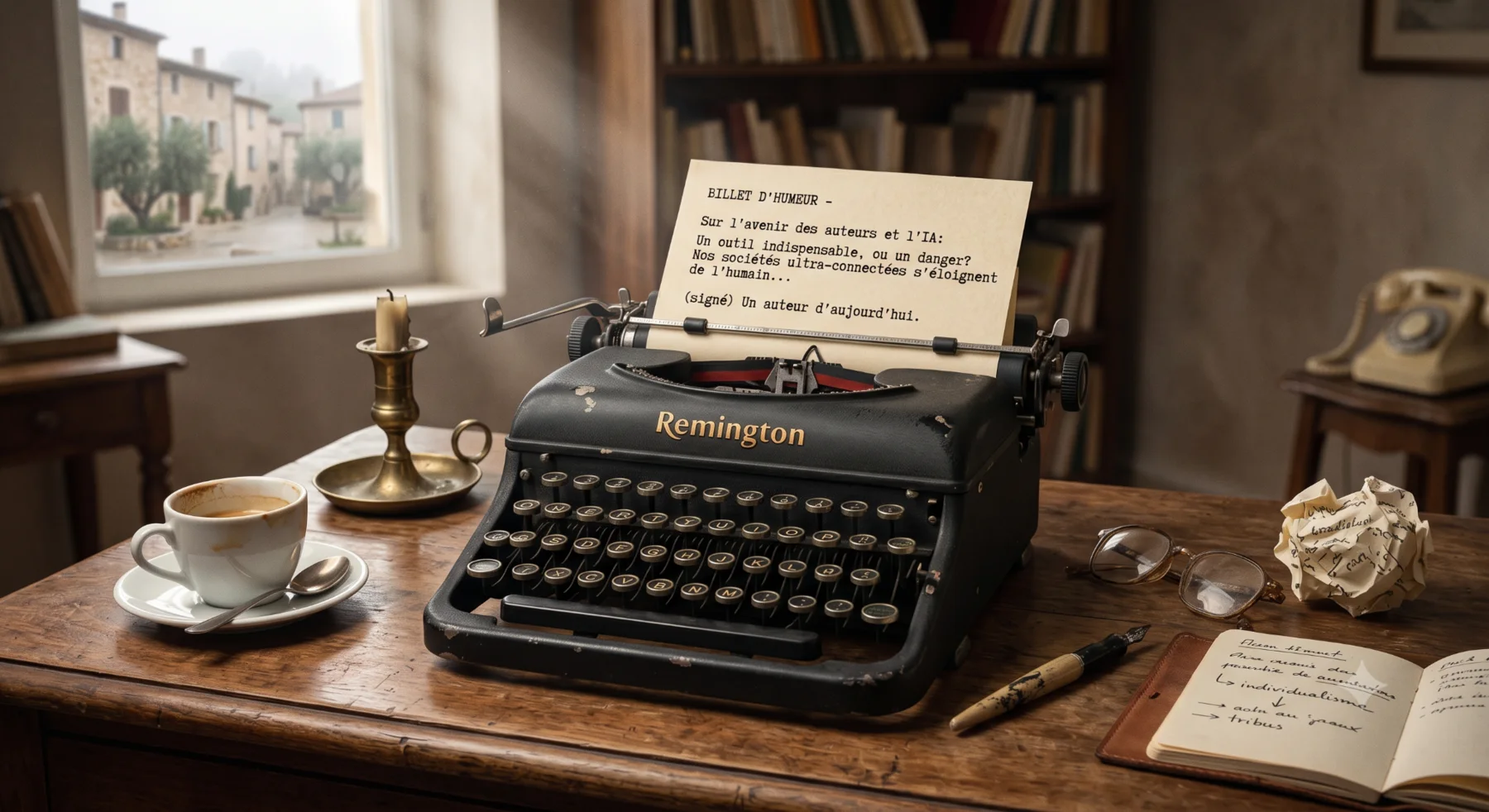
Even if a world without mobile phones wouldn't displease me at times, I have to admit it has become an indispensable tool. AI is following the exact same trajectory. The era of the writer locked in an attic, pounding away at a Remington typewriter until the break of dawn, is officially over. We must live with our time.
Tomorrow: The Literary Market Crash and the Human Element
Progress is so rapid that the status quo won't last for years. We are perhaps only months—maybe even weeks—away from the moment an AI can generate a gripping 400-page novel without losing the thread.
What will happen then? The book market will likely experience a shockwave—an editorial crash faced with a surge of one-click generated texts. Then, as always, the market will self-regulate. Because even if AI offers all kinds of novels—good or bad, depending on the skill of the person prompting it—the essence of creation won't disappear.
There will always be a tortured author writing by hand in a corner to exorcise their demons, out of absolute necessity or sheer pleasure.
The Real Danger: Human Alienation
Beyond literature, the real danger of these technologies lies elsewhere. We are building hyper-connected societies where talking to machines or strangers across the globe has never been easier. Yet, the more this connectivity advances, the more humans retreat into themselves.
We have become deeply individualistic, rediscovering our sense of "tribe" and community only during major disasters or epidemics. AI is just another mirror reflecting this modern solitude.
What about you, reader?
Facing this unpredictable wave sweeping over our lives and bookstores: does Artificial Intelligence frighten you, fascinate you, or do you deliberately choose to stay out of it altogether?